
In this article, I'm not going to just explain that we need money. I'm going to show you why the party leadership simply cannot ask members to do that alone and then outline my thinking on how we can do political fundraising differently to others.
I know this topic causes alarm bells to ring for some members, but we are the party of material reality, and we have to be clear about our own. That is my job as someone running to be leader - not platitudes, but reality.
Seven minutes
Last Wednesday was the third hustings of this leadership election. It was the first one where anyone asked about how we are going to fund the party's growth.
In six hours of hustings we have spent seven minutes talking about money.
Now, the risk of talking about this here is to lean into the charge from my opponents that I am 'treating the party like a startup'. But this party needs to grow. My first and foremost focus for growth is to get us more members and candidates - because votes are the only currency that really matters in politics. But to get there, we do need the more literal currency.
Growing this party requires many difficult and concrete things to happen. Ideas will not carry us to Parliament alone. We will not be able to compete against political megaliths when they have pockets full of pounds and we have a pocketful of wishes. We know good ideas don't win on their own merits, because if they did William Clouston would have become Prime Minister.
Most importantly for me: all our good ideas will mean nothing to the people, families and communities of this country if we remain this small and underfunded. That's why so much of my plan is about getting our own house in order - members, candidates, data, money. I just want to see A Britain That Can again.
The environment we're competing in
Labour took in £45 million last year. Reform - famously - received far more. Even the billionaire-bashing Greens took c.£7m.
The major parties are also vast organisations. Restore, the newest entrant on the block, has more than 50x our membership and a growing network of local branches and candidates.
We don't want to emulate the other parties, but we do have to beat them.
I keep hearing idealistic ideas about how members can do this alone, and to me it's the same strain of thinking as Net Zero: a principled idea that must be protected even as it cuts us off at the knees, and even if there are better ways to achieve the same result.
So let's look at exactly what it takes for members to do this alone rather than just make the claim.
The minimum viable party
To even start becoming electorally viable, we will need £5m by the 2029 general election. For comparison, the Greens raise more than that in a single year. It is still more than we have ever raised.
But we want to redefine the politics of this country; we won't get to do that lightly.
Can members fund it?
Move the slider to see how many members it would take to raise £5m from membership fees alone by the election.
new joiners growing 16.5% a month
Raised by May 2029
£558k
£4.44m short of £5m
This is about my target, 10 times our size today. It's ambitious, and I think we can do it. It would raise about £558k from members, and we'd need another £4.44m to reach £5m.
How this is worked out
- We start with 2,000 members in November 2026.
- New members pay £4 a month (£48 a year). Existing members keep the £3 a month they joined on, because their rate is grandfathered.
- About 1 in 65 members leave each month (1.5%).
- Membership is roughly flat today, so we start at about 30 new members a month, which replaces the members who leave. The slider sets how fast that number of new members grows each month, compounding.
- Recruiting each new member costs £5. That covers comms, printing and postage, and is a low estimate.
- The count runs for 31 months, from November 2026 to May 2029.
- £5m is what it takes to run a competitive national party up to the election. It is the total, not a budget line.
| Month | Members | Joining that month | Raised so far |
|---|---|---|---|
| Nov 2026 | 2,000 | 30 | £6k |
| Feb 2027 | 2,033 | 47 | £24k |
| May 2027 | 2,134 | 75 | £42k |
| Aug 2027 | 2,343 | 118 | £63k |
| Nov 2027 | 2,718 | 187 | £86k |
| Feb 2028 | 3,354 | 295 | £115k |
| May 2028 | 4,401 | 467 | £153k |
| Aug 2028 | 6,094 | 737 | £204k |
| Nov 2028 | 8,808 | 1,165 | £279k |
| Feb 2029 | 13,132 | 1,841 | £389k |
| May 2029 | 20,000 | 2,909 | £558k |
Party sizes are rough, recent public estimates, shown for scale: Liberal Democrats about 60,000 (Oct 2025), Greens about 216,000 (Mar 2026), Reform about 270,000 (Dec 2025 to Mar 2026). Sources: Political party affiliation in the UK, Reform UK membership numbers.
But growth isn't steady like this. What about a surge?
In the real world, growth is lumpy. There is a possibility that one big event could bring us many thousands of members. But we need money to get us to that one big event in the first place, and we need money to have the machine in place to make sure any large influx of members can be looked after.
Having a plan for growth means we can adapt to changes along the way. A surge would be a great problem to have.
Where do we get the money?
Many of our members already give a great deal, in money, time and shoe leather. I asked the conference hall in Scarborough who had given to the party and there was a sea of hands. But we need donors as well, and I think that's existential for the party - without them, I honestly don't see how it survives.
I know some members are wary of big donors, and they're right to be. I wrote in October about how British politics is paid for: a handful of people now fund most of it, and that's a real risk. So let's think about how fundraising works and how we can head off the risk.
Why people give money
Believing in the cause is just one part of it. My day job is helping hard tech companies raise money. People also need to feel that what they're funding is credible, and in my experience that comes down to a minimum of three things.
1. A plan. Staged, costed, with milestones they can see us reach. Most donors will want to see what the first donation achieved before giving any more money.
And it has to be a plan for growing seriously. We don't want a personality cult, and we don't want to grow in a way that caps how far we can go. The people we'll be asking for money can sniff out nonsense. They'll need to see a credible strategy they believe we can deliver. Which brings me to...
2. A team. People who've run things, built things, failed, been accountable when it went wrong, and have credibility. That's one of the many reasons I asked William Clouston to stay involved, because as a widely respected politician he increases our credibility enormously. It's also why I'm building a team of experienced people around me now, before the result.
3. An ambition they're willing to back. Too big an ambition and it will seem like lunacy. Too small and it's just uninteresting. I've thought carefully about my ambition for the party, and worked out the steps to get there. It won't be easy, but it is doable.
Raising money is attritional, unglamorous work. Even with the right plan and the right people, it's going to be hard. I'm under no illusions about that.
Potential donors
I've done some analysis on the kinds of people who may donate. Some outside the political donor sphere altogether. Some perhaps realigning. The groups below are working hypotheses, and we'll learn more with every conversation, but this is who I think will fund a serious SDP.
The builders. People who've made their money running something physical - manufacturing, construction, logistics, food, hospitality, retail, leisure. They're watching energy costs, rates, regulation and NI changes make Britain a harder place to do business, when there's simply no need for it. We may be the first political party they see that actually speaks to what they want for the country and need from a government. This is by far the biggest group on the list.
The people who left the left. Mostly entrepreneurs, professionals and cultural figures. They gave to Labour and other parties of the left for years but have now walked away over antisemitism, women's rights, or because they felt the left had stopped respecting the people it was founded to represent.
The investors. People in finance and family offices who want to put money into something that they believe can genuinely change the fortunes of the country. I doubt they'll be our first backers. We'll need to build the evidence first that we can turn money into results.
What these people have in common is that they can see where this is heading. A country that has stopped building, can't pay its way, and is already seeing civil unrest is not a good place to leave your children or grandchildren, however much you've put aside for them.
Protecting the idea
Whoever we look to for donations, one thing is clear: we cannot allow money to change our course. We have watched legacy parties hawk off bits of themselves until they become an incoherent and compromised shell of what they were. The SDP cannot go out like that!
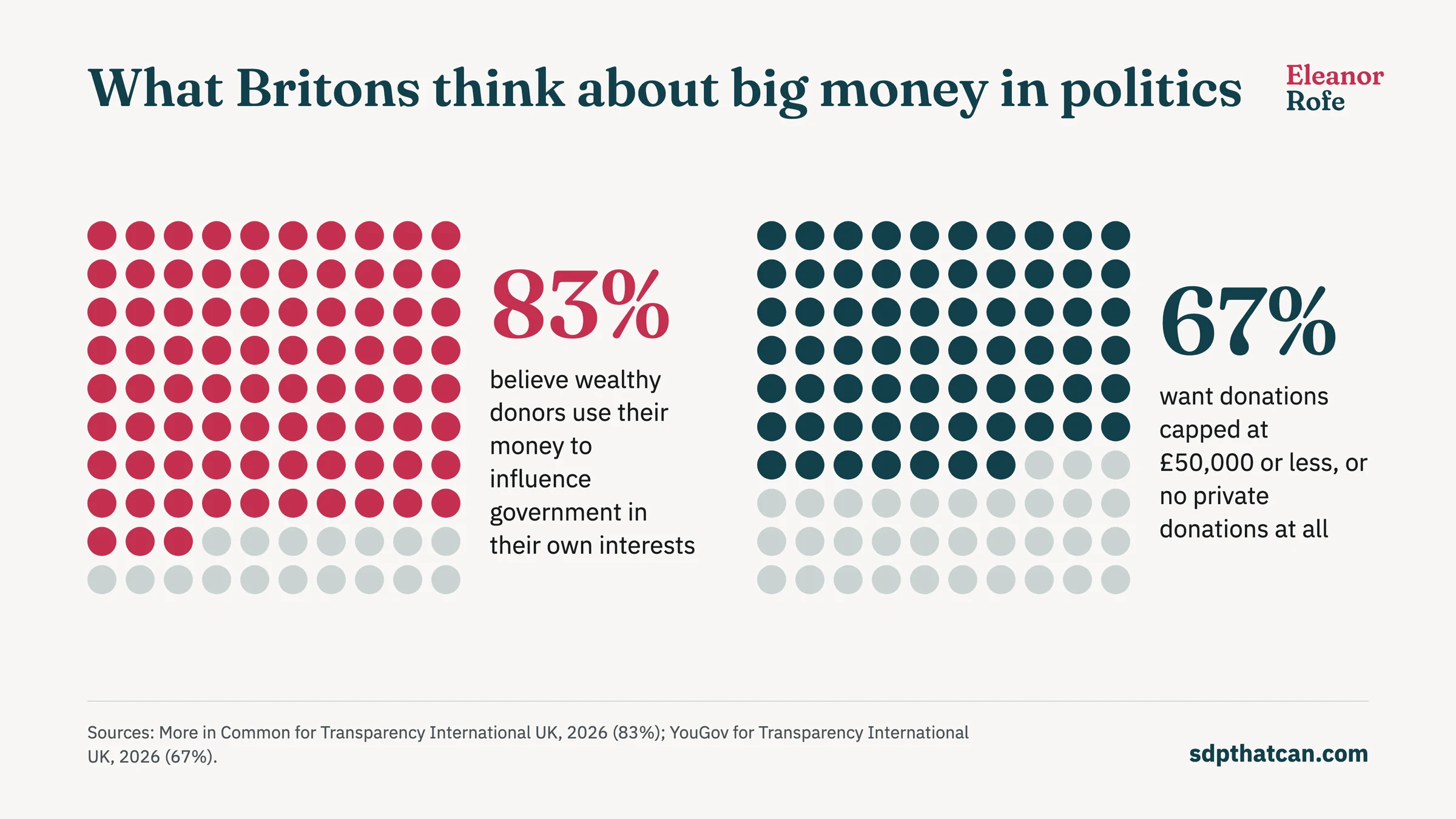
So my view is that we look for many smaller donors; doing that reduces their risk and our dependency.
We could even experiment with a transparency pledge, where donors confirm they are giving money because they believe in the vision we have set out, not because they are trying to change it. And that pledge, in turn, protects them. A party that raises money transparently is fairer to its members, and it reassures donors they won't get caught up in a scandal.
In September, Reform took £72m from just two donors. That gives them a lot of firepower. I got their 'newspaper' delivered just the other day. They can flood the airwaves. But they're also having to counteract what that £72m means, and how much it has set a large swathe of the country against them.
Done properly, the way we raise money can be our advantage. Can we compete with £72m? No, we can't. But can we be the party that proves politics can be funded differently? I think so.
The material reality of the party of material reality
Every policy we talked about during the six hours of hustings - the National Care Service, apprenticeships, buying British, reindustrialisation - needs MPs to make it happen. To get MPs we need candidates and proper campaigns, and those cost money. We need tens of thousands of members, which requires comms, network effects and people like Maryse Pomlett and Danielle Baldwin Rowe doing the hard work so the party welcomes and keeps them. The whole system has to pull together. Without money, all our amazing policy work is for nought. With it we have a programme for government.
So when you're deciding how to vote, look beyond the vision each of us has for the party and the country, and ask one more question:
I've set out my answer, along with my ambition for the party and the team I'm building here. That's why I'm asking for your vote.
A Britain That Can needs an SDP That Can.