
Everybody says money is ruining politics, but very few people talk about why that is, or suggest another way of doing it. That's what I'm going to try to do with the SDP.
Here are some numbers on how British politics is paid for, and why I think the way a party raises money decides its future.
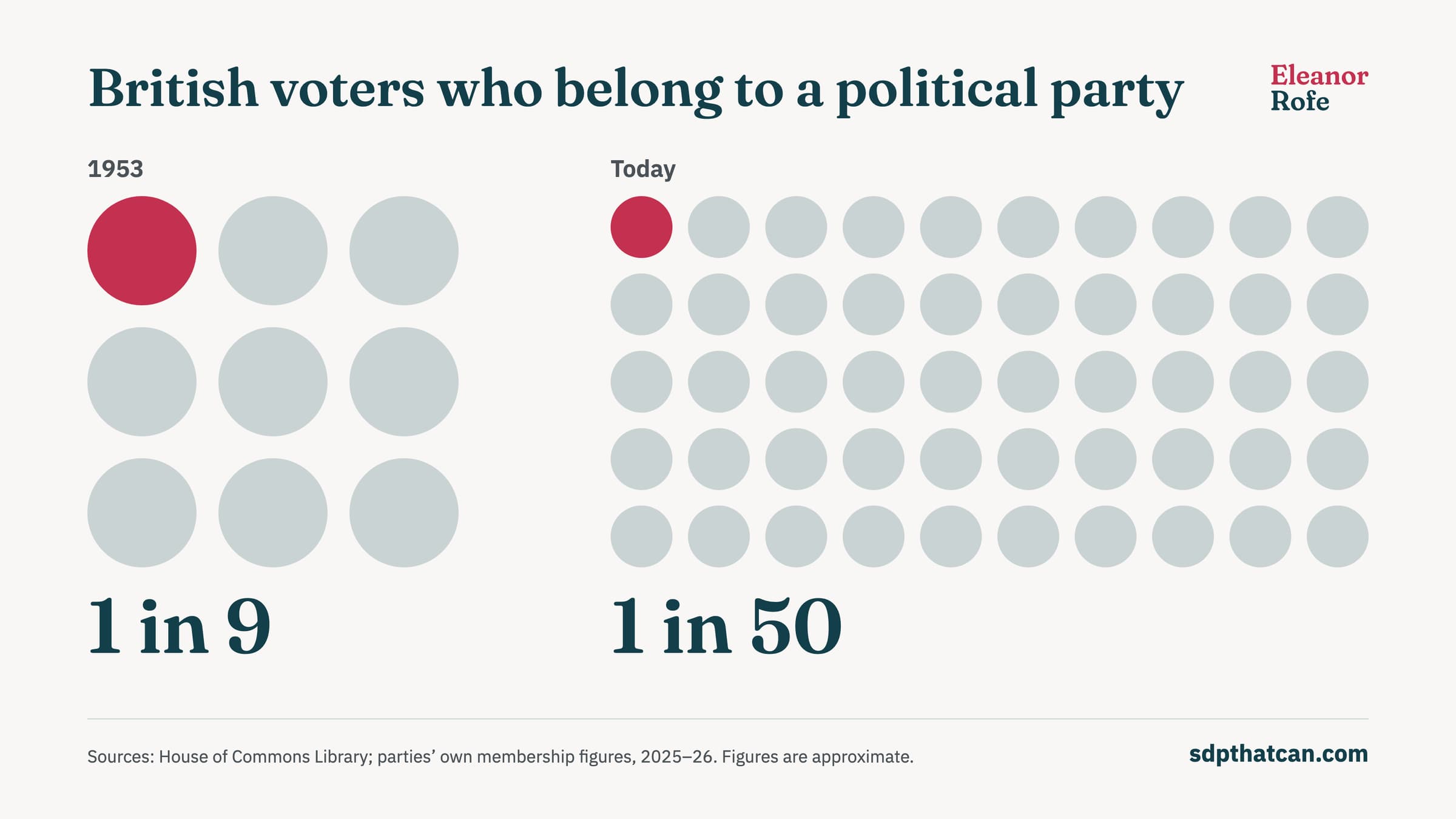
In 1953, about 1 in 9 British voters belonged to a political party. Today it's about 1 in 50.
Parties used to be paid for by their members. Mostly, they aren't any more.
What replaced them is an increasingly small number of people.
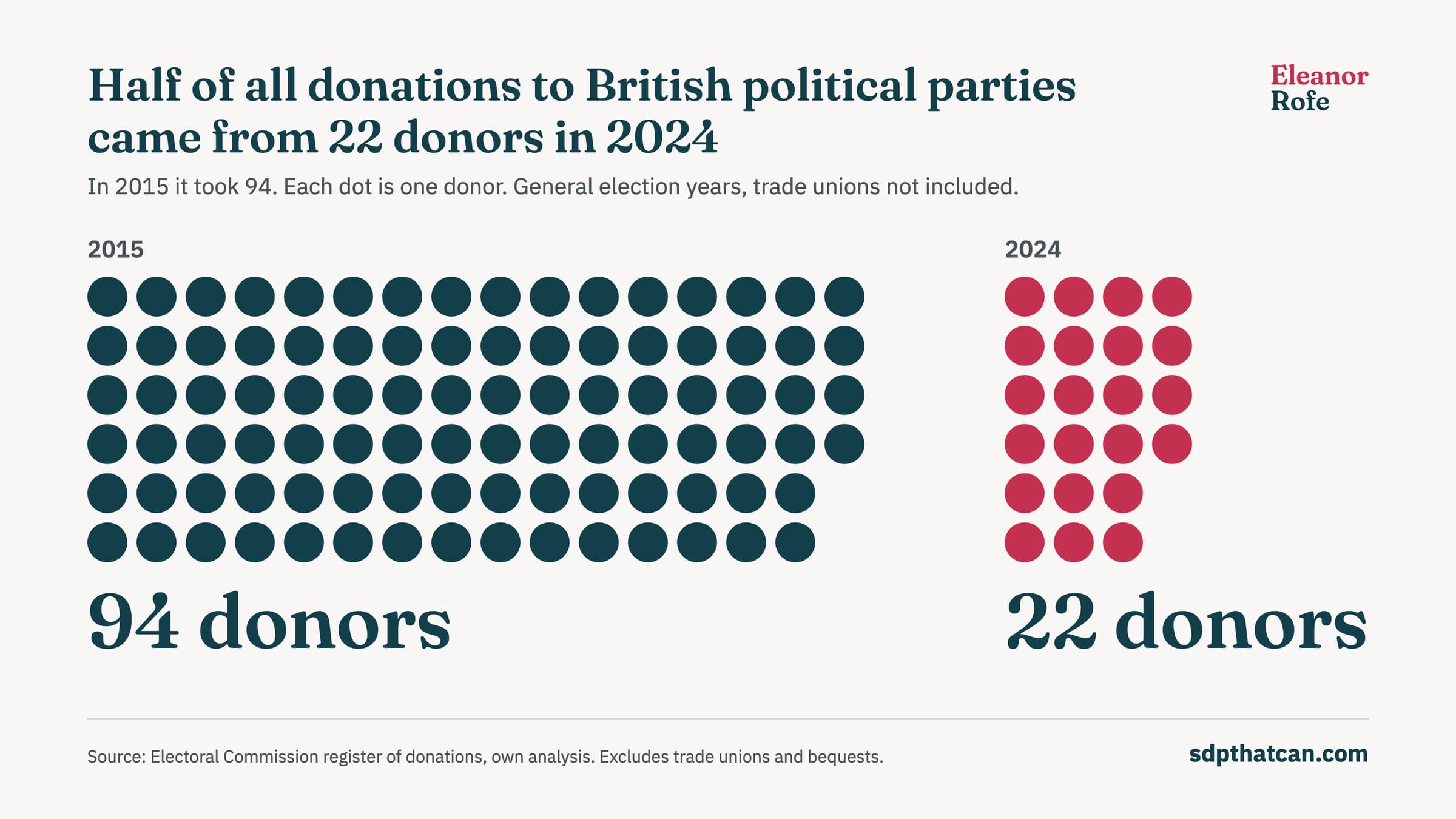
In the 2015 election year, it took 94 donors to supply half of all non-union donations. In 2024, it took just 22.
Donors giving £1m or more went from 8% of that money to 46%, after inflation.
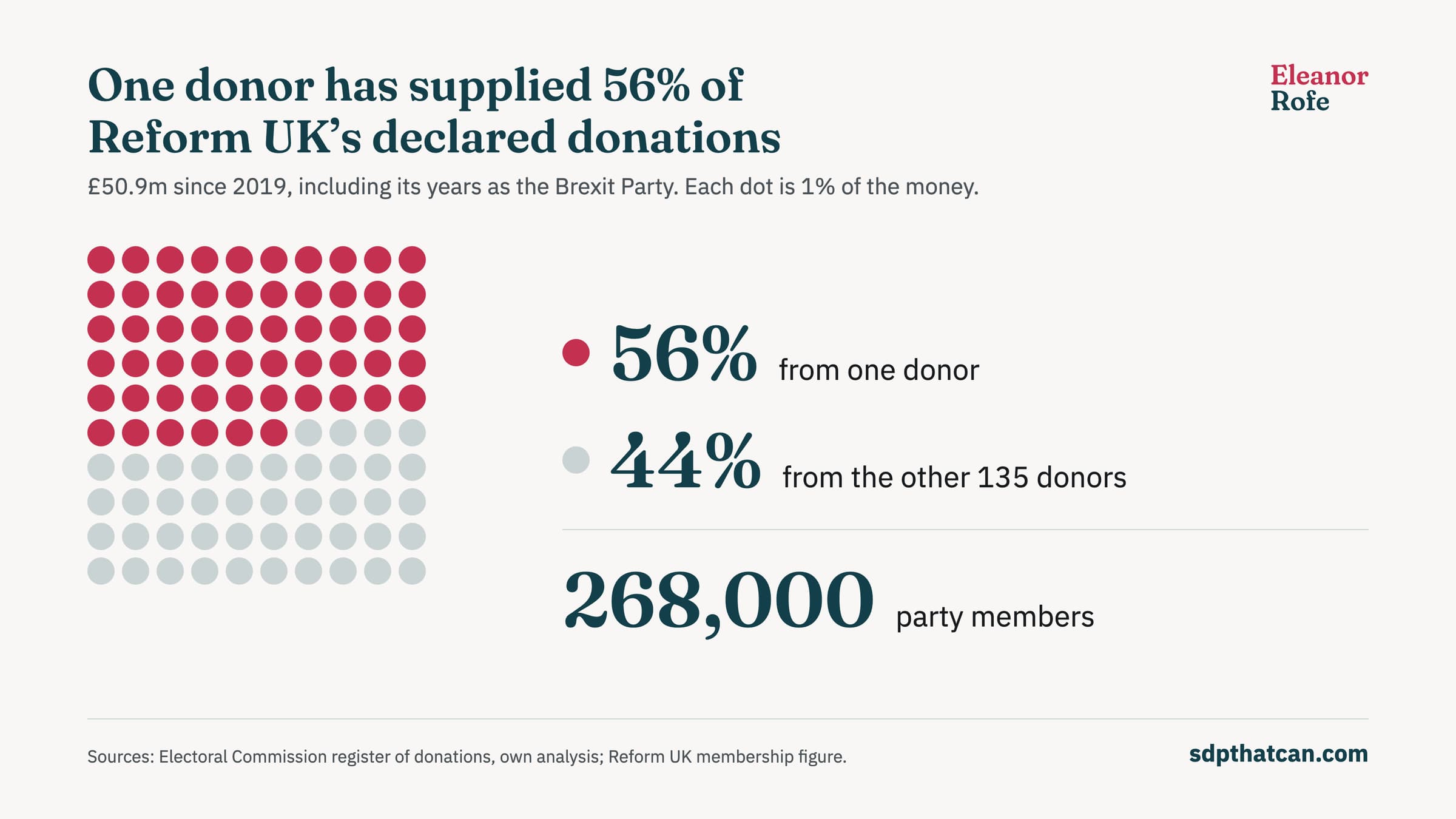
New parties are the extreme of this. Reform has 268,000 members - a lot for our era. Yet until this autumn's megadonations, one man had supplied more than half the funding (stats for declared donations is below).
Now two men have supplied more than three-quarters.
Several smaller parties have been funded by fewer than ten people, and some by just one.
I get why, by the way. It's fast. If you have people who believe in you and happen to be very, very rich, one massive cheque gets you staff, ads and momentum, without having to go out and ask 50, 60, 70 times.
But it brings risks. The obvious ones are scandal and capture. But there's a less obvious one.
It's easier for one person to believe in a bad plan, and put money behind it, than it is for 20 or 50. When the donors get more concentrated, so does the belief.
Maybe, just maybe, it's more disciplined to produce a plan that 20 or 30 people will back. You spread both the concentration and scandal risk. But you're also testing the plan. Twenty donors asking questions you hadn't thought of is better than one asking none.
I come from hard-tech fundraising, so I would think this way. But the SDP is starting unencumbered here, which gives us a massive opportunity to try something different: not to look for the single cheque that takes everything to the next level but to find the broad belief base.
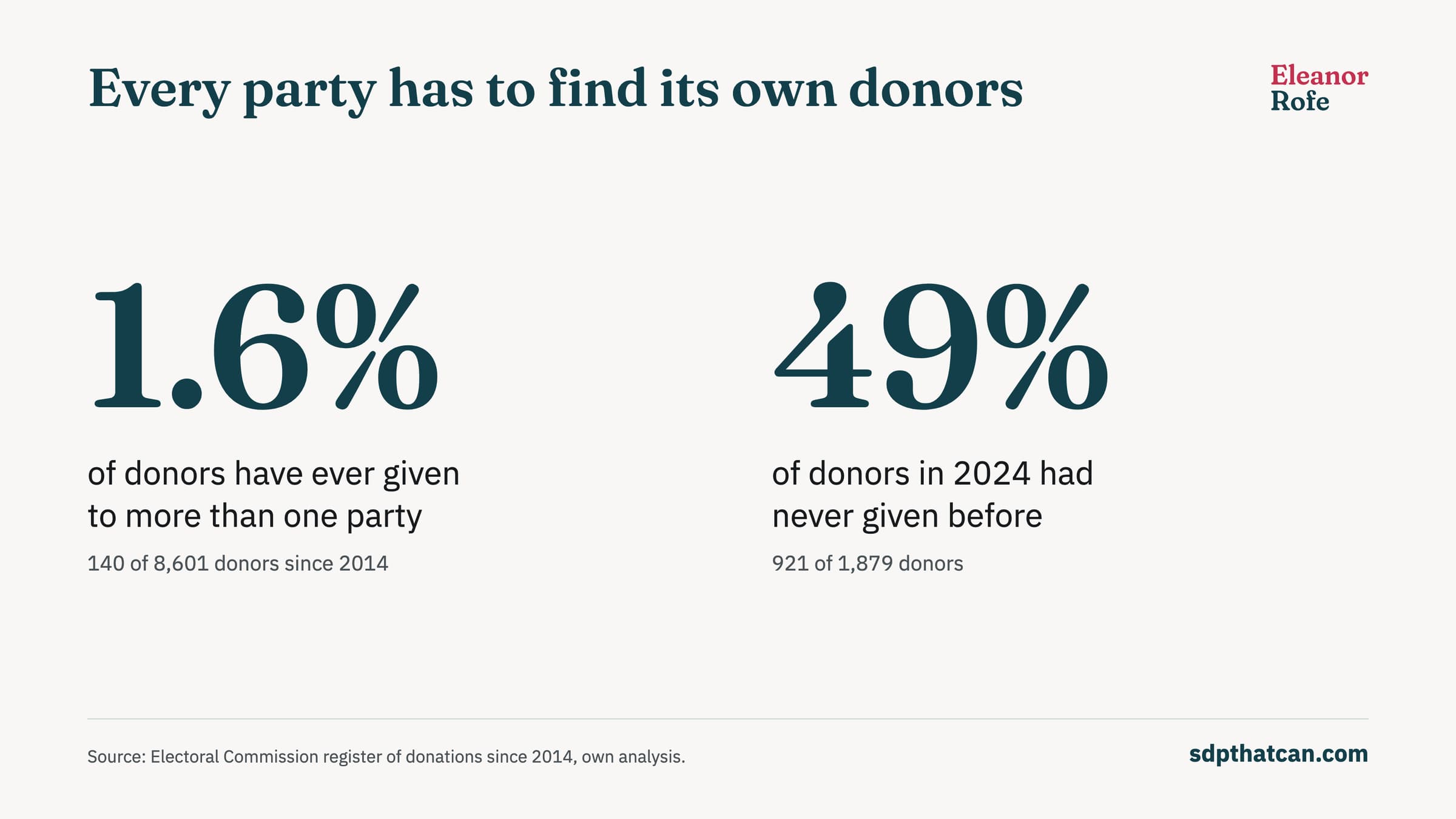
Now, people have said the SDP can't be funded because it doesn't appeal to traditional political donors (finance, unions etc). But donors almost never move between parties anyway: fewer than 2% have ever given to more than one. And in 2024, almost half of all donors had never given before.
Like singers or comedians, every party has to find its own audience.
I think ours are most probably people who have built things, especially in physical industries. They know what impossible land prices, planning, regulation and energy costs do to a business. Our energy policy, our long-term economics in the national interest, and a social market where public and private work together in the right ways all speak to them. They'd be backing a programme we already publish, for the whole country: a Britain that can, in place of a Britain run by can'ts.
There is also a potential for people who used to back, e.g. Labour, but cannot stomach their refusal to stick up for women's rights or children's health.
So we say: this is what we're raising, because this is our plan, and you can back us knowing other people believe in it too. We're building a cohort of people who back the ambition, the plan and the team.
That lowers the risk for a donor as well. You know you're not the only one.
The question I ask about everything as SDP leader is whether it helps us now and whether it's sustainable. In two, three, five years, will we have built solid foundations, or shaky ones that can be buffeted by light winds?
Reform had that wobble this summer: from a clear lead in the polls, they dropped after Clacton and months of headlines about its funding. Their numbers are starting to creep up again. But who knows whether it gets back the clear lead it had - or whether trust has been permanently lost along the way.
So I want seed backers: a broad group who back the plan and the team early. No single person we couldn't afford to lose. Nobody so invested they'll do anything to make it work. Each signs a pledge: no access, no favours, nothing in return. And we sign one back: we'll do everything we can to deliver on the ambition.
It'll be slower and harder than finding one rich patron. But I think the SDP offers the electorate something unique, and we can't afford to lose that as we grow.
And we do policy for the next generation, not just the next election. Let's see if we can do fundraising that way too.
I'll be putting these ideas to members for discussion and challenge on Tuesday 6 October, 7pm.
Sources and notes
All donation figures are my own analysis of the Electoral Commission's register of donations, covering mid-2014 to March 2026. Only donations above the legal reporting thresholds appear on the register, so "donors" means donors of declarable sums. Public funds and impermissible donations are excluded. Electoral Commission register
Party membership
- 1953: the Conservatives claimed 2.8m members and Labour over 1m, 3.8m in total. Both figures are thought to be inflated. House of Commons Library, Membership of political parties in Great Britain UK Parliament, Partied out
- The 1951 electorate was 34,919,331. 3.8m members is about 11% of that, or 1 in 9. 1951 general election (Wikipedia)
- Today: Reform 268,631; Labour 264,754 (end of 2025); Greens 225,000+ (April 2026); Conservatives 123,000 (July 2025). These four total about 881,000. Adding my estimates for the Liberal Democrats (about 60,000) and the SNP (about 56,000) gives about a million. Party figures often run high. Reform (LBC) Labour (LabourList) Greens (The Canary) Greens (Green Party) Conservatives (Wikipedia)
- The 2024 electorate was 48.2m. About a million members is 2.1%, or 1 in 48, rounded to 1 in 50. House of Commons Library, General election 2024: Turnout
- "Mostly, they aren't any more" holds for the larger parties. The Greens are the exception: declared donations were never more than 19% of central party income in 2019 to 2024.
How concentrated donations are
- "Non-union donations" means donations from individuals, companies, limited liability partnerships, trusts and unincorporated associations, excluding bequests.
- Number of donors supplying half of that money in each general election year: 94 (2015), 70 (2017), 36 (2019), 22 (2024).
- Share of that money from donors giving £1m or more in 2024 prices: 8% (2015, 5 donors), 18% (2017, 7 donors), 41% (2019, 18 donors), 46% (2024, 17 donors).
- The inflation adjustment uses the ONS CPI all-items annual index (2015 = 100.0, 2017 = 103.4, 2019 = 107.8, 2024 = 133.9). ONS, CPI index
New parties
- Reform UK (including its years as the Brexit Party) has declared £50.9m in private donations from 136 donors since 2019. One donor gave £28.7m of it, which is 56%.
- Parties funded by fewer than ten declared donors, from the same register: The Reclaim Party (1 donor, £4.3m), Open Party (1), Your Party (2), The Independent Group for Change (4), True & Fair Party (6), Renew (8).
Donors and parties
- 140 of 8,601 party donors (1.6%) have given to more than one party since 2014. This excludes public funds and donations from other political parties.
- In 2024, 921 of 1,879 donors (49%) had not appeared on the register in any earlier year back to 2014.
Reform's polling
- Reform's poll average fell from about 27% to about 23–24% after Nigel Farage announced his resignation from the Clacton seat on 7 July 2026 and after funding allegations. The funding claims are allegations and a police investigation is under way. Al Jazeera AOL inkl Britpolls, September 2026 average
- "Starting to creep up again": YouGov, 27–28 September 2026, Reform 25% (up four), Labour 24%. YouGov